
My After Action Report
And what I learned.

Cassidy Steele Dale writes to equip you with the forecasts, foresight skills and perspectives, and tools you may need to create a better, kinder world.
And one of those ways is to tell you three things I learned from speaking in public again.
So a few weeks ago I told you about a ministry conference I was slated to speak at — on disarming hatred — and I did that last weekend outside of Asheville, North Carolina: the United Methodist Peace Conference. If you remember, I’d been debating during my prep about how much/to what degree to show photos of dead victims of one of the great mass shootings in history. Because I have a lot of those photos. I decided not to because I figured that that audience probably wouldn’t need any sort of wake up call as to how bad the Christian nationalist hatred-and-violence problem had gotten because they — and we — already know.
But I way, way underestimated who these folks would be.
These weren’t regular ministers; these were professional subversives. And they were there not for mere reassurance and comfort but to fill their pockets with blasting dynamite because they’ve each got a cliff or a wall somewhere to take down.
How could I tell the difference? Regular folks’ faces say Tell me something that helps me. Professional subversives’ faces say Give me tools I can use to help others. These folks’ faces said the latter.
Or that’s what I saw in their faces just before I rhetorically fell on mine.
See, when I say I have bad luck with technology I mean I’m one of those people who has that magnetic field that makes TV remotes fail. My microwave currently hates me. I’m no longer allowed to stand near servers.
It’s bad. No one believes me until they see it happen for themselves. Not even this conference’s organizers.
So when it was my time to speak they gave me a lapel microphone with a belt-clip pack and a clicker to flip my PowerPoint slides and neither worked at first. I kept hitting the power button on the waist pack but it wouldn’t light up so I kept saying Test test test. Can you hear me? Is the mike hot?
And then the microphone suddenly popped on at full volume just as I blurted out AM I HOT?
Everyone laughed and my soul briefly left my body, bounced around on the ceiling like a happy-face balloon for a few seconds, and then unfortunately returned to me.
Now, full disclosure: Longtime readers of Think Future know that this is what I look like in real life.

Finally I decided I didn’t need my dignity anyway. I scooped what was left of it and put it in my pocket where it demagnetized my credit cards.
Worse yet, my 12-year-old daughter, SnarkDaughter, was there to see the whole thing. So, you know, hooray. When I turned 12 my dad started taking me with him when he worked with churches so I took her on this trip. So when Beautiful Wife and our 10-year-old son Dervish picked us up at the airport later the first thing SnarkDaughter said was Mommy, Daddy asked everybody if he was hot! and Beautiful Wife — eternal pilot of our TV remote because I’m me — put two and two together that there was probably a mike check problem and turned to me and said Did the East German judge give you a 6? (Stay back, everyone: She’s mine.)
But back on stage I collected myself, told a nice long story about mass murder and then I explained why people kill for God.
I told the Anders Breivik story. In 2011 Breivik, a Christian nationalist terrorist, blew up Norway’s White House and attacked Norway’s equivalent of a Young Democrats’ summer camp. He killed 77 people that day in Western Europe’s bloodiest day since World War II. I gave you some of that story in that previous post.
And then I gave them the main lessons out of my two e-books: The Knight and The Gardener: Worldviews Make Worlds and Combat Theology: How to Weaponize and De-Weaponize a Religion. And then I pointed them here to Think Future where I sometimes talk to us about religious and political violence.
All through while I was speaking — about every third sentence — one section or another of the audience would sorta grunt like I’d punched them in the stomach. I couldn’t figure out what the grunt meant but realized I’d honed every third or fourth sentence to land and so maybe I was just hearing the Methodist version of Amen or Preach on or something. Or maybe I was just punching them in the gut because it was tough, unsentimental material. I never figured it out and I didn’t ask. But I realized my style on stage had changed. I used to be more verbose and self-impressed by my own verbosity. Now what I say is short, direct, and impossible.
The Q&A time and the breakout session afterward were brutal. See, because they were already professional subversives they didn’t ask easy questions; they asked extremely genius-difficult questions. Since I am not a genius — I’m merely difficult — I gave the best answers I could. And all the answers I gave them are answers I’ve given you here over the course of Think Future. So you didn’t miss anything.
But when the discussion in the breakout session turned to the future of hate I gave them my scenarios for the future of the United States of America because which scenario we wind up in gives you the type of hate we’ll have to reckon with.
Here’s the scenario matrix from that project but you should read the whole post so this matrix makes full sense. (You may have to embiggen it.)
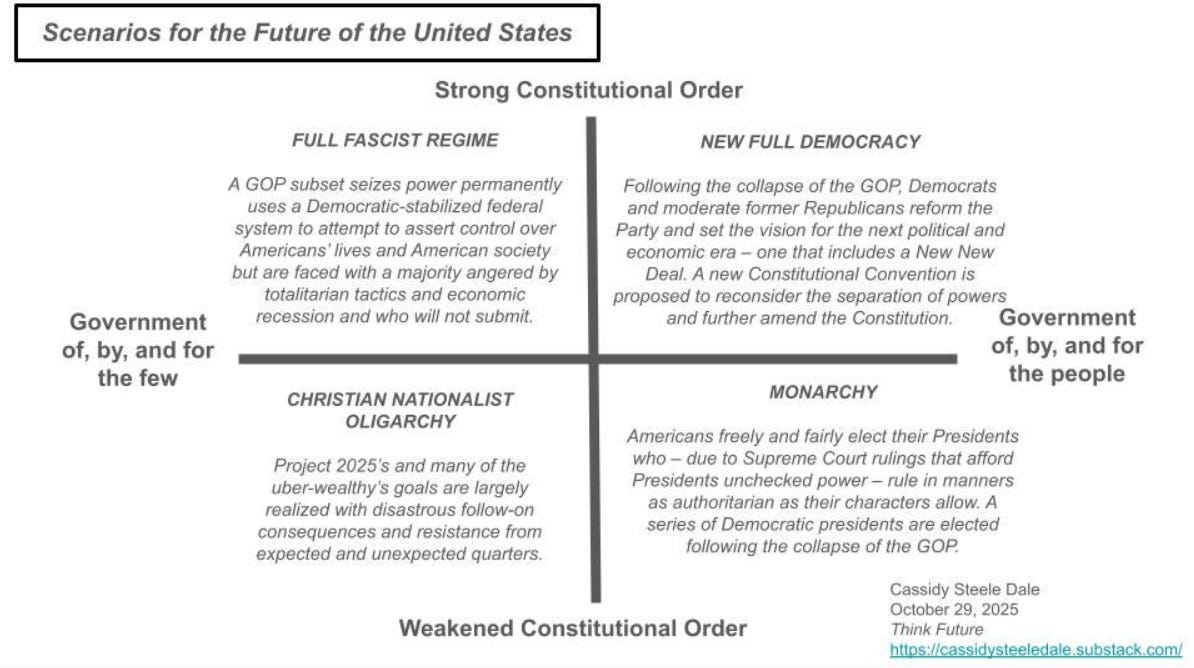
I laid them out as four possible futures ahead but when I introduced the New Full Democracy scenario (and why it’s possible despite all of this current darkness) some folks in the room sat straight up like I’d hit them with an electric jolt.
And then the “But” questions began.
“But” questions are disbelief questions. Every futurist gets them when he or she says a better future is possible.
Scared people never challenge negative future scenarios — they already believe those can happen.
Scared people always challenge the positive future scenario when they can’t accept one is possible. And peace activists these days are scared people because peace has been getting its ass kicked for a long time now.
“But” questions are always framed like “But what about this awful thing or that horrible thing?”
For cynics, “but” questions contain all their reasons to hold onto their happy, comfortable cynicism. Cynics laugh in the face of optimists — even when those cynics live in a present-day world that past optimists made real.
For professional subversives, though, it’s half laughing-disbelief and half-I’m-shaking-every-last-tree-to-find-what’s-left-in-order-to-clear-the-final doubts-from-my-resolve.
This time it went like:
You say the future is going to be magically unicorns-and-rainbows better?
No, I said it’s one of the four possible futures — three of them are bad — but the majority of Americans’ energy is now pointed toward that better future. Our current government isn’t, though, and it’s very possible that we might wind up in one of those three bad scenarios no matter what the majority of Americans want.
But what about the SAVE America Act and all the people they’re trying to disenfranchise? Don’t you think it’s going to get through and pass like every-horrible-thing-else lately?
No, I don’t. As legislation it’s scary but in Congress it’s Dead on Arrival.
But what about the growth of racist beliefs among young people?
Sure, it’s growing but what we’re seeing is loud racism not large racism. What I mean by that is that yes, racist and antisemitic beliefs among Generation Z is somewhat larger than older generations — conservative media and social media and Trump get most of the credit for that — but that segment among Gen Z (the most diverse American generation ever) is still small within that generation and still small in most American generations. Racism will always be an original sin and will always be with us (I’m not a utopian) but we are less racist, antisemitic, and sexist than we used to be, and just because one generation has a marginally greater number of racists in it than the generations before it does not mean that racism is going to return and rule the future. And just because Trump and his people were able to successfully trick just enough of a sliver of economically-driven independent voters into reelecting him doesn’t mean that racists are going to rule the future forever. But if you believe that that’s going to be the case — that racists will win or that they are the undeniable tide — then I’ve given you three other future scenarios to believe in. But that racists are in their glory today doesn’t mean that they will be tomorrow, especially given the demographic wave that’s coming and because the GOP is probably going to die (or not be able to win the presidency again for a long time) when Trump is gone.
I don’t know that I convinced anyone, (Sometimes my optimism comes across as dismissive of cynicism and the cynical rather than an attempt to counter it and them.) I’ll keep trying either way.
But the first two things I learned from this were (1) Say better/other things during mike checks and (2) Have better (and better-prepared) answers to “but” questions.
As for the third thing I learned:
Originally, the organizers of this conference asked Brian McLaren to come speak and he said No, you need to ask Cassidy instead and so I said If Brian says I should, then I’ll be there in 10 minutes with bells on. (Brian, thanks for pointing them toward me and me toward them: they were seriously wonderful.)
Brian McLaren and I have been friends for 25 years. If you don’t know him: among Gardener-leaning Christians he is a Big Deal and has been for decades now. (His latest nonfiction book is Life After Doom.) In years prior he would call me when he was discouraged about the future of the country or the world. Now he doesn’t — because he doesn’t have to. All the things I’ve said to him in the past are the things I say to you now. He just reads me here now. He’s reading this along with you right now.
Shortly after I started Think Future Brian told me he was surprised I’d found my voice as a writer so quickly and I said This is just how I talk. So I write the way I talk.
At dinner, in the dining hall later, SnarkDaughter and I sat alone. (I was afraid she was coming down with Dervish’s strep throat by then. So we kept our distance.)
She asked Some of those people sounded like they were mad at you. What did you do?
I didn’t say anything for a minute because I was losing my temper with pessimism and she could tell I was building toward a rant — the kind I usually leave in writing here to you — until I focused myself back down.
I told her very quietly I said things some of them can’t believe yet. Sometimes I say things that are too early to believe.
They’re afraid that Trump will win. They’re afraid that ICE will win. They’re afraid that cruelty is about to win forever.
They don’t know yet that THEY — and everyone like them — are why we are gonna win and make everything better.
At which point SnarkDaughter pointed her little battery-powered fan into my face — the one I bought her earlier that day in case she popped a fever on the plane ride back — and said Cool down, Daddy.
And then I got my third lesson: Aw crap, on top of writing the way I speak, now I speak the way I write.
Which means I’ve changed, for better or for worse. I used to be a deep cynic, back before we lived in this world in which only cynicism can be believed.
But now I’m like this every day.
I was at the Peace Conference at Lake Junaluska. Reading and absorbing Knights and Gardeners. Your presentation was super helpful for me. I enjoyed the Q and A afterwards. I am also a fan of Brian McLaren. His writings helped me in my 40 years of ministry. I am also a fan of our Bishop in Western NC, Ken Carter. He speaks with so much wisdom and really addresses issues of our time. And your daughter rocks, helpful in the Q and A!. I look forward to your wisdom in the present and the hopeful future.
My father also has the same technology issues. He can make a brand new computer quit to the point that no IT professional can fix. It's like you say, there is a magnetic field around him.
I love your optimism, especially the point about present cynics living in a pass optimists future. Sometimes all I need is a vision on where Im going. I know others are the same. Thank you for sharing your visions.